When it comes to dairy processing, turning fresh milk into a stable, concentrated product requires careful control at every stage. Pranam Ji Engineering Works helps dairy businesses build efficient processing systems designed around their production needs. Evaporated milk is widely used in beverages, bakery products, confectionery, desserts, sauces, and other food applications. An evaporated milk plant combines several important processes, including milk reception, filtration, standardization, pasteurization, evaporation, homogenization, filling, and sterilization. Because a large portion of the water naturally present in milk is removed during processing, the final product has a richer consistency and longer shelf stability when properly processed and packaged.
What Is Evaporated Milk?
Evaporated milk is a concentrated milk product made by removing part of the water from fresh milk. Unlike sweetened condensed milk, evaporated milk does not normally contain added sugar as its defining ingredient. The concentration process gives it a creamy texture and characteristic milk flavor.
Producing high-quality evaporated milk requires more than simply heating milk. Temperature, pressure, concentration level, fat content, microbial safety, and packaging conditions all need to be controlled carefully.
How Is Evaporated Milk Made?
Although individual plant configurations may vary, the basic process generally follows these stages:
1. Raw Milk Reception
Fresh raw milk arrives at the dairy facility in hygienic milk tankers or containers. The milk is checked for quality parameters before entering production. Tests may include checking acidity, fat content, solids-not-fat, temperature, and microbial quality.
2. Milk Standardization
The composition of milk can naturally vary from one batch to another. Standardization helps achieve the desired fat and solids content in the final evaporated milk. This step is important because consistent formulation contributes to uniform taste, texture, appearance, and nutritional characteristics.
3. Pasteurization
The standardized milk is heat-treated to reduce harmful microorganisms and improve product safety. Proper temperature and holding-time control are essential during this stage. Pasteurization equipment is generally integrated with temperature monitoring and control systems so that the milk receives the required heat treatment without unnecessary overheating.
4. Preheating
Before evaporation, milk may undergo a controlled preheating process. This treatment can influence the properties of milk proteins and help achieve the desired characteristics in the finished product. The exact preheating conditions depend on the product formulation and processing design.
5. Evaporation
Evaporation is the central stage of an evaporated milk plant. Here, part of the water is removed from the milk to increase its concentration.
Industrial dairy plants commonly use vacuum evaporation because operating under reduced pressure allows water to evaporate at a lower temperature than it would under normal atmospheric conditions. This helps reduce excessive heat exposure while efficiently concentrating the milk.
6. Homogenization
After concentration, the milk may be homogenized to improve the distribution of fat throughout the product. Homogenization reduces the size of fat globules and helps create a smoother, more stable product.
Proper homogenization contributes to the creamy appearance and texture that consumers generally expect from evaporated milk.
7. Cooling and Intermediate Handling
After the required concentration and homogenization conditions are achieved, the product is cooled or transferred through controlled intermediate processing stages. Maintaining hygienic conditions is especially important because contamination at this stage can affect final product quality.
8. Filling and Packaging
The processed milk is filled into suitable containers using hygienic filling equipment. Packaging protects the product from contamination and supports its shelf stability. Depending on the product and packaging system, containers may undergo further heat treatment or sterilization to achieve commercial stability.
9. Sterilization
Commercial evaporated milk is generally subjected to an appropriate sterilization process after filling or through an aseptic processing and packaging system. The objective is to achieve microbiological stability while maintaining desirable product characteristics.
The selected sterilization method depends on the product formulation, packaging type, equipment design, and required shelf life.
Main Equipment Used in an Evaporated Milk Plant
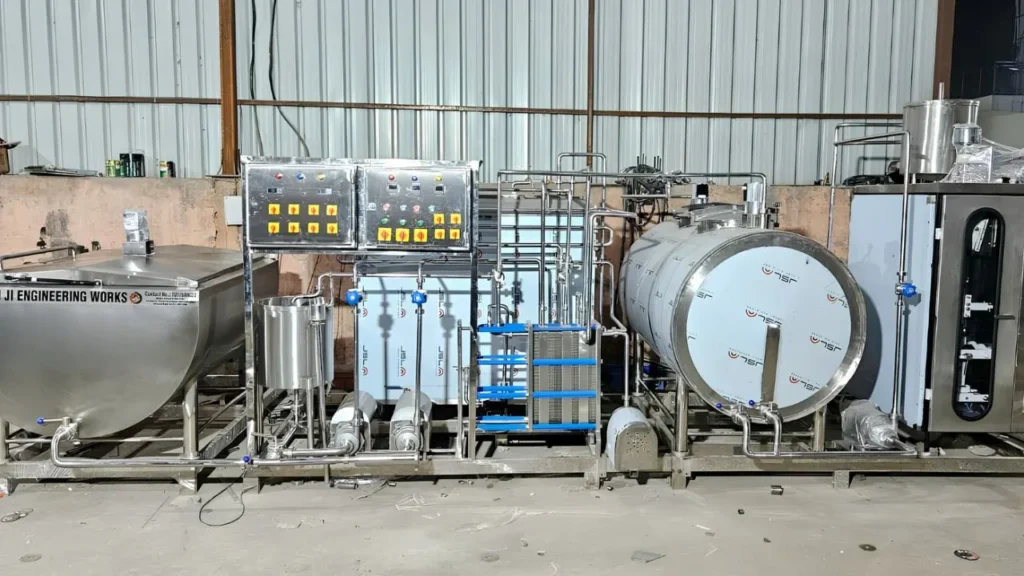
A complete production line can contain several specialized machines and systems. Typical evaporated milk plant equipment may include:
- Raw milk reception and storage tanks
- Milk filtration and clarification systems
- Standardization tanks
- Pasteurization units
- Preheating systems
- Vacuum evaporators
- Homogenizers
- Product transfer pumps
- Cooling systems
- Filling and sealing machines
The exact configuration depends on production capacity and the desired level of automation.
Why Choose Pranam Ji Engineering Works?
Setting up a dairy processing facility requires practical knowledge of both machinery and production flow. Pranam Ji Engineering Works understands that every dairy business has different capacity, space, formulation, and automation requirements. Our company can offer customized engineering solutions for businesses planning an evaporated milk production facility.
From individual processing equipment to a more integrated production setup, the focus is on creating a system that is practical, hygienic, efficient, and suitable for commercial operations.
From fresh raw milk to a packaged shelf-stable product, evaporated milk production involves a carefully controlled sequence of operations. Milk reception, standardization, pasteurization, preheating, vacuum evaporation, homogenization, filling, and sterilization each play an important role in the final product.
A professionally planned evaporated milk plant brings these stages together into one coordinated system. With suitable equipment and reliable engineering support from Pranam Ji Engineering Works, dairy businesses can develop a production line that supports consistent quality, efficient processing, and future growth.